About Beyond Tribes
Can a species built for belonging to groups learn to cooperate at the scale of a planet?
Why this project
There is already an enormous body of knowledge about human cooperation, conflict, identity and prejudice.
Evolutionary biology asks how cooperation could evolve at all. Anthropology and history show how human groups expanded from small communities into societies, states and nations. Psychology investigates identity, conformity, threat and the remarkably easy formation of in-groups and out-groups. Political science studies institutions and power. Researchers in peacebuilding, education and conflict resolution test ways of reducing hostility and rebuilding trust.
But these conversations often take place separately.
Beyond Tribes is an attempt to connect them.
It asks not simply why humans divide, but what our growing knowledge of ourselves might allow us to do differently.
What Beyond Tribes explores
The project follows a series of connected questions.
How did an ape become capable of cooperation on the scale of civilisation? Why is belonging so central to human identity — and why can belonging turn so easily into exclusion? Why do nations, religions, political movements and other groups command such extraordinary loyalty? What causes disagreement to become hostility, dehumanisation or violence? Why do shared global threats so often fail to overcome national or ideological divisions? Can institutions be designed to work with human psychology rather than constantly fighting against it? And, ultimately, can the circle of human cooperation expand far enough to deal with problems that no tribe, nation or ideology can solve alone?
Beyond Tribes does not begin with the assumption that tribalism can simply be eliminated. Group identity is deeply woven into human social life and can be a source of meaning, solidarity and extraordinary cooperation.
The more interesting question may be whether those instincts can be understood, redirected and nested within something larger.
Humans have become a planetary force
without yet becoming a planetary community.
How the project works
Conversations
In-depth dialogues with thinkers, practitioners and change-makers.
Essays
Clear, rigorous long-form writing on the big questions.

Research
Evidence and analysis that deepen understanding and challenge assumptions.
Solutions
Exploring ideas and experiments that could help us cooperate better.
Who is behind Beyond Tribes?
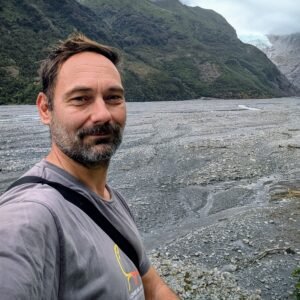
Beyond Tribes was started by Dr. Greg Torda, an ecologist and evolutionary biologist. After roughly three decades in science, one question became increasingly difficult to ignore.
Many of the largest challenges facing humanity are no longer primarily problems of missing information. We often understand the science surprisingly well. Yet knowledge alone does not guarantee collective action.
Again and again, scientific problems become problems of politics, identity, trust, incentives, inequality and cooperation.
Beyond Tribes grew out of an attempt to understand that gap.
Greg is not approaching the project as an expert with a grand theory of human society. His role is closer to that of an investigator: bringing together people who have spent their careers studying different pieces of the problem, testing ideas across disciplines and asking what those insights mean when considered together.
An experiment in progress
Beyond Tribes is at an early stage.
The questions are being developed, the first conversations are being planned and the project itself will evolve as new evidence, perspectives and people are encountered.
That openness is deliberate.
The ambition is not to begin with an answer and assemble arguments around it.
It is to ask a difficult question:
How far can human cooperation go?
And then see where the evidence leads.
Open process
Across disciplines

Follow the evidence